Time Management |
The ability to estimate how much time is available, how to spend it, and how to stay within time limits and deadlines. Time management is also the ability to have a sense of urgency - the notion that it is important to accomplish a task within a designated time frame.
|

|
Students with ADHD have a lot of difficulty estimating how long a task will take. For some, because they don't think ahead, time is "now." For others, staying focused on something for really long periods of time (hyper-focus) is another manifestation of time-blindness (think, playing a computer game or checking FaceBook until 3 a.m. and then looking up to discover it's 3:00 a.m.).
While all of us may have overextended obligations that can occasionally give rise to what appears to be a deficit in time management, students with difficulty in time management consistently miscalculate how long tasks will take, have difficulty sticking to a schedule they (or others) have set, and chronically run late. |

|
Time Blindness |
|
|
Parents manage time for children in childhood but by the time children reach adolescence, they are expected to begin to manage their schedules more independently. Two issue arise as children become adolescents. Teens struggle with time planning and also in developing a sense of urgency. The teen underestimates how long it will take to do a task he finds boring (like writing a paper) and overestimates how much time he has to complete that task (i.e., it is not due until Wednesday; that's a whole day away). The sense of urgency to get it done occurs, just as it does in all of us, but for students with time management difficulties, this sense of urgency is late to arrive, leaving little time to actually complete the task. |
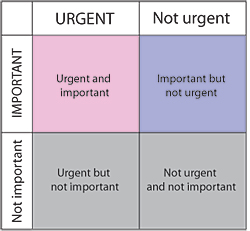
Because students with difficulties in time management may also struggle with planning and prioritization, a tool like the one below, can be useful in addressing both areas. Students can list tasks that have to be done, identify which category these go into, and then create a more effective to-do list.
|
There are two different principles in managing this deficit in students.
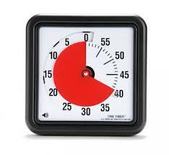
First, create external references to the time period for the assigned task. These are generally tasks that are being done "now." External references include visual timers, clocks (analog!), and other ways for them to "see" time passing.

|
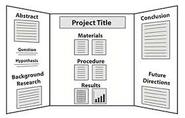
Second, bridge time for tasks involving longer intervals. Break assignments into smaller steps so that the student can complete those steps as part of daily routine (every day, I do the next step of my science project). The student is very likely going to need help to identify those steps and to assign time frames. Additionally, reminders about those time frames will occur frequently.
|
Backwards time planningKeep in mind that for many students, the idea that you have to "get ready" for an activity before the actual activity is scheduled to begin is unknown. Thus, learning to include time to get ready for an activity needs to be included in time management. In the example to the right, you can see a way of strategizing time using backwards time planning. "Showing" time is critically important.
|
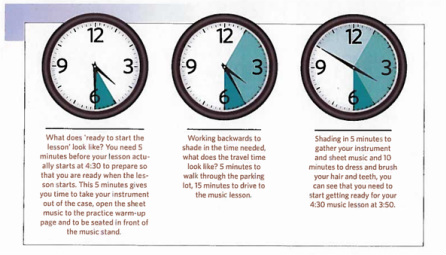
From an article in the journal "Attention" by Sarah Ward and Kristen Jacobsen.
|
|
|
Helping students "see" where their time is open and available to engage productively in tasks they need to do requires making time "visible." The strategy described in the video on the left is one way to do this.
|
For ideas on how to help students with time management, see the document below.

Click here to go back to the list of Executive Functions so that you can choose where to go next.
|

Forward to goal-directed persistence!
|
