Executive functions: What are they?
Executive functions are cognitive processes that allow people to plan, organize, make decisions, pay attention and regulate behavior.
|
It
might be helpful to think of executive functions as a set of mental
processes that help us connect past experience with present action (so
what we do "now" affects "later.") Everybody uses executive function
skills. We use them to solve problems and evaluate our actions so that
we can change them if the outcome is not what we want. These skills are
critical for success in school and in life.
You should know that there isn't really an agreed-upon "set" of executive function processes nor a common definition of the term. This means that, depending on what you are reading, you may have to work harder to put the information into action. But,even though there is no single, agreed upon definition of the term "executive functions," there is general agreement that executive functions are necessary processes. Within executive functions, there are subsets of skills (or processes); these skills may have multiple names, depending on who is discussing them. For example, Dr. Russell Barkley talks about response inhibition as one of the executive functions. Dr. Thomas Brown doesn't identify response inhibition as one of the executive functions but he describes the same skills as "monitoring and self-regulating actions." |
While there are different names for the subsets of skills that make up executive functions, these subsets actually work in tandem so separating them and addressing them separately is hard. To see a list of EF, the definitions and some examples, take a side trip! Click the button below to go there. Be sure to come back here when you are done.

What executive function would sticky notes help to accommodate?
|
Understanding what EF is is important so let me repeat stuff here!What is executive function? According to the National Center for Learning Disabilities, executive function is a set of mental processes that helps connect past experience with present action. People use EF to perform activities such as planning, organizing, strategizing, paying attention to and remembering details, and managing time and space.
I'd suggest you go take a look at their info on EF. This will take you "out" of this website so be sure to come on back! Click the logo to go the the NCLD website. 
Let's bring it back to ADHD. |
This book chapter comes from Causes & Cures in the Classroom: Getting to the Root of Academic and Behavior Problems by Margaret Searle. It's really helpful and could easily be shared with others. I strongly suggest reading this chapter all the way through! Don't procrastinate (do you remember which executive function this might be?).
|
This resource will take you awhile. It may become a better resource as you move forward. It comes from NCLD. You can find it here: http://www.ncld.org/images/content/files/executive-function-101-ebook.pdf
Barkley (1997) proposes that a lack of response inhibition is the primary and distinguishing factor of those with ADHD. Response inhibition refers to a child's ability to prevent himself from performing a behavior (response) or to stop an ongoing behavior. This is the building block of executive function. All the other executive functions depend on response inhibition to develop.
Examples of poor response inhibition:
*Interrupting while someone else is speaking (we call it impulsivity, right?)
*Forgetting to raise one's hand and blurting out an answer (more impulsive behavior)
*Being unable to stop while running through the house (we call this hyperactivity)
*Getting stuck in an activity or "zoning out" (is this inability to focus or distractible?)
According to Barkley, this inability to control one's responses begins when a child is learning to internalize language (thinking verbally, instead of talking out loud). This is especially related to self-direction (telling oneself to do something, such as "Stop", "Concentrate", "Focus", or "Calm Down"). Barkley argues that children with ADHD are not able to direct their behavior internally, the same way other children do because of how their brain has developed. ***(see note below). For example, children learn to direct themselves verbally, repeating known expectations and rules. This "external" or out-loud behavior gradually becomes "internal" or silent. Barkley proposes that children with ADHD have difficulties with this process.
This combination of inability to prevent habitual behaviors and responses, the inability to internalize language, self-direction, rules and expectation, leads to the symptoms and struggles of ADHD. These are executive functions.
Examples of poor response inhibition:
*Interrupting while someone else is speaking (we call it impulsivity, right?)
*Forgetting to raise one's hand and blurting out an answer (more impulsive behavior)
*Being unable to stop while running through the house (we call this hyperactivity)
*Getting stuck in an activity or "zoning out" (is this inability to focus or distractible?)
According to Barkley, this inability to control one's responses begins when a child is learning to internalize language (thinking verbally, instead of talking out loud). This is especially related to self-direction (telling oneself to do something, such as "Stop", "Concentrate", "Focus", or "Calm Down"). Barkley argues that children with ADHD are not able to direct their behavior internally, the same way other children do because of how their brain has developed. ***(see note below). For example, children learn to direct themselves verbally, repeating known expectations and rules. This "external" or out-loud behavior gradually becomes "internal" or silent. Barkley proposes that children with ADHD have difficulties with this process.
This combination of inability to prevent habitual behaviors and responses, the inability to internalize language, self-direction, rules and expectation, leads to the symptoms and struggles of ADHD. These are executive functions.
|
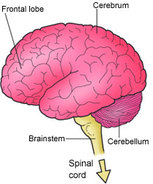
****We won't get into medical and brain issues at this point in our journey but suffice it to say that research implicates several areas of the brain, most importantly, the frontal lobe, in the development of ADHD. Click the button to hear Dr. Russell Barkley explain it!
Be warned that Barkley says the information he will share is like being seated in front of an open fire hydrant!
|
Thomas Brown suggests that cognitive difficulties: the syndrome of executive function impairments, are the core of ADHD.
His categories are:
1. Activation: organizing, prioritizing, and activating to work
2. Focus: focusing, sustaining, and shifting attention to work
3. Effort: regulating alertness, sustaining effort, and processing speed
4. Emotion: Managing frustration and modulating emotions
5. Memory: Utilizing working memory and accessing recall
6. Action: Monitoring and self-regulating action
His categories are:
1. Activation: organizing, prioritizing, and activating to work
2. Focus: focusing, sustaining, and shifting attention to work
3. Effort: regulating alertness, sustaining effort, and processing speed
4. Emotion: Managing frustration and modulating emotions
5. Memory: Utilizing working memory and accessing recall
6. Action: Monitoring and self-regulating action

Now that you've looked at ADHD and at EF, let's take a look at how one affects, and explains, the other!
|
In case you want to go "see" where you are....
|
